Notice
Identify a cue that already happens reliably, such as finishing coffee or closing a laptop.
Habits
Habit change is less about heroic motivation and more about reducing friction. Most health advice fails quietly, not because a reader lacks willpower, but because the plan asked for a version of life that does not actually exist on a Tuesday evening after a long commute. Valour approaches habit design as an engineering problem: identify the cue that already happens, attach a small action to it, make the first step visible, and review the result without turning a missed day into a verdict on character. This page sets out a practical method you can apply to movement, meals, sleep or screen time, along with a short comparison table, a four-part process and a few prompts for a calmer weekly review.
Put walking shoes near the door, keep a water bottle where work happens, or place a short mobility sequence beside a familiar evening routine. The environment can carry part of the reminder, which matters because willpower is a limited and unevenly distributed resource across a demanding week. A visible cue removes the need to remember an intention from scratch every single day, and it shortens the distance between deciding to act and actually acting.
Friction works in both directions. If a habit is difficult to start, even a motivated person will skip it on a tired evening; if an unwanted habit is difficult to start, even a tempted person will often let it go. Rearranging a kitchen counter, charging a phone outside the bedroom, or pre-portioning a snack are small structural choices that quietly shape outcomes more reliably than a strongly worded personal rule.
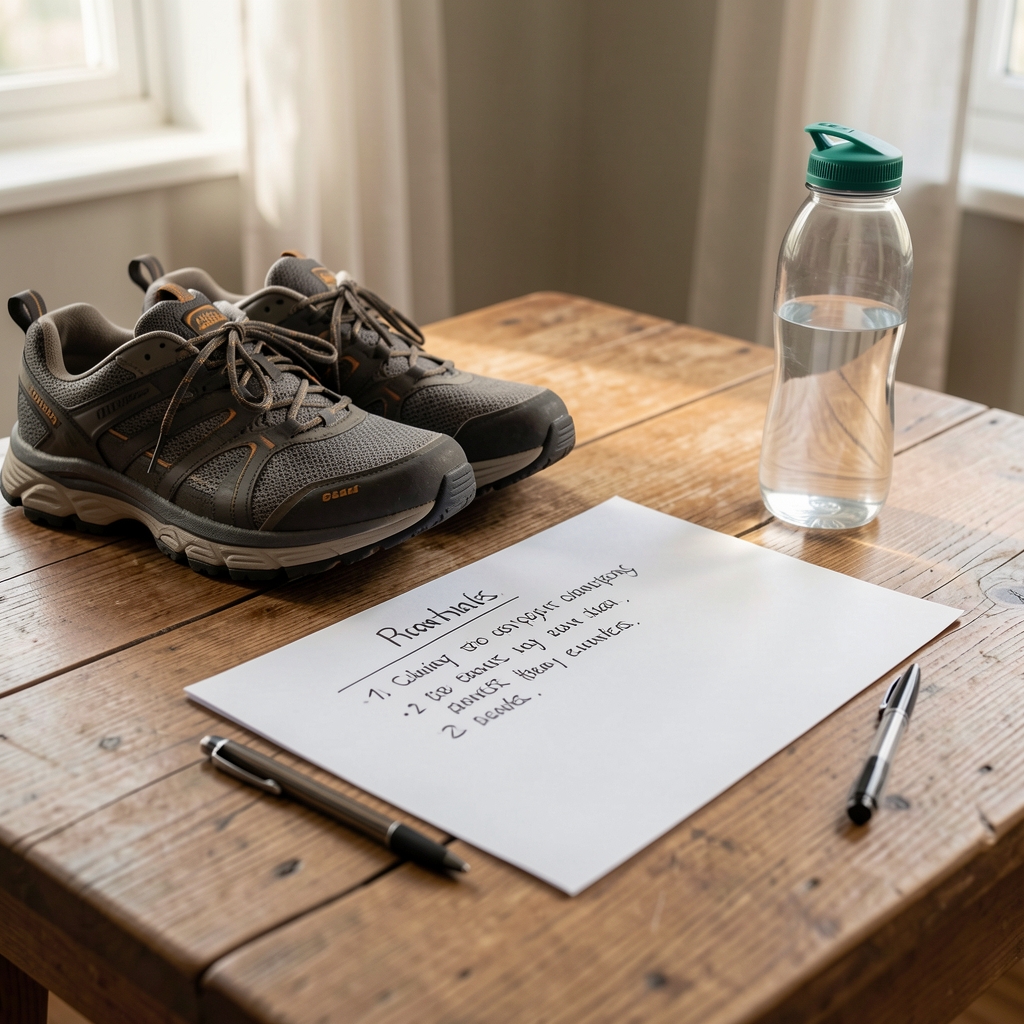
Identify a cue that already happens reliably, such as finishing coffee or closing a laptop.
Link one small, specific action to that cue rather than a vague intention to try harder.
Repeat the pairing in low-stakes moments until it feels ordinary rather than effortful.
Look at the pattern across a week, not a single day, and adjust the cue or action if it is not holding.
| Friction | Why it stalls a habit | A practical adjustment |
|---|---|---|
| Too many decisions | Choosing what, when and how each time drains attention before the action starts | Decide the day before and remove choice at the moment of action |
| Unclear starting point | A vague goal like "move more" has no obvious first step | Define the smallest possible version, such as a ten-minute walk |
| Competing priorities | Work, family and travel can crowd out a plan built for an ideal week | Keep a reduced backup version for busy days instead of skipping entirely |
| No visible feedback | Without a record, progress feels invisible and motivation fades | Keep a simple weekly note rather than relying on memory alone |
| All-or-nothing thinking | One missed day is treated as proof that the plan failed | Treat a missed day as data, not a verdict, and resume the next cue |
A routine does not need to be impressive to be worth repeating. Many readers assume a health habit only counts if it is demanding, visible to others or dramatically different from what came before. In practice, a modest action repeated consistently over months tends to outperform an ambitious plan abandoned after two weeks, simply because consistency compounds and intensity alone does not. This is part of why Valour's guides generally favour a smaller first version of a habit over an aspirational full version.
A plan becomes trustworthy when it can explain a missed day without turning it into a verdict.
— Habits desk
If a routine keeps collapsing despite reasonable effort, that is useful information rather than a personal failing. It may point to a cue that is not reliable enough, an action that is still too large, or a week that genuinely has less capacity than the plan assumed. Adjusting the design, rather than repeating the same attempt and blaming discipline, is usually the more productive next step.
The same notice, attach, rehearse, review structure applies to movement, nutrition, sleep and stress routines covered elsewhere on Valour.
Return to the foundations